Read Blocking in Volleyball: How to Watch the Play and Close the Block
Learn how read blocking in volleyball works, what blockers should watch before jumping, and how to respond to the setter, attacker, and ball trajectory.
Read blocking in volleyball is a defensive technique in which a blocker observes the developing play before deciding where and when to move. Instead of committing immediately to one attacker, the blocker reads the pass, setter, set, and hitter’s approach, then closes the most likely attacking option.
The aim is not always to score a stuff block. A good read block can slow the attack, take away the strongest angle, or direct the ball toward a waiting defender. This makes the technique useful for middle blockers and wing blockers at school, club, and elite levels.
What read blocking means
A read block is based on information gathered during the rally. The blocker starts in a balanced position, watches the opponent’s actions, and delays the final blocking decision until the set becomes clearer.
This differs from a commit block. In a commit block, the blocker follows a planned assignment and jumps early with a particular attacker, often to stop a quick middle attack. In read blocking, the player keeps more options open and reacts to the setter and the ball.
The main cues to watch
- The quality of the pass: A tight pass near the net may allow a quick attack, while a pass pushed away from the net can limit the setter’s options.
- The setter’s position: A setter moving away from the net may have fewer fast-set choices and may send a higher ball to an outside or opposite hitter.
- The setter’s hands and shoulders: These can provide an early indication of the direction and height of the set, although blockers should not rely on them alone.
- The hitter’s approach: The attacker’s angle, speed, and distance from the net can reveal whether the likely shot is a hard attack, tip, roll shot, or off-speed hit.
- The ball’s flight: A high, slow set gives the blocker more time to move. A fast set requires an earlier, more decisive response.
How to perform a read block
Effective read blocking volleyball technique combines court awareness, footwork, and timing. The blocker should stay ready without becoming upright or leaning toward one side.
- Start in a neutral position. Face the net with knees bent, hands in front, and weight balanced over both feet. Keep enough distance from the net to move laterally.
- Track the pass and setter. Identify whether the setter can run a quick play or is likely to send a higher ball to the pins.
- Hold your position briefly. Do not chase the first movement of the attacker. Wait for reliable information from the set and approach.
- Move along the net. Use a shuffle or crossover step to get in front of the likely hitter. Keep the hips and shoulders facing the net.
- Arrive before takeoff. The final step should put the blocker in a balanced position. Jumping while still moving sideways often creates a gap.
- Penetrate over the net. Reach the hands across the net with strong fingers and firm wrists, while keeping the shoulders controlled.
- Land under control. Bend the knees on landing and prepare immediately for a deflection, tip, or transition attack.
Read blocking against different attacks
Against an outside hitter
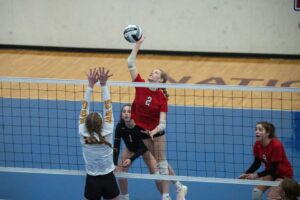
The outside blocker should first identify whether the set is inside, tight, or far from the antenna. A set inside can give the hitter more angle options, while a ball near the antenna may reduce the available cross-court space. The blocker should coordinate with the back-row defense instead of trying to cover every angle alone.
Against a middle attack
The middle blocker must distinguish between a quick set, a front-one attack, and a delayed ball. Watching the passer and setter helps determine whether the middle threat is realistic. If the pass is poor, the blocker may have more time to read the set toward an outside or opposite attacker.
Against the opposite hitter
At the right side of the net, the blocker reads the set location and the hitter’s shoulder direction. Communication with the middle blocker is essential because the two players must close the seam and decide which attacking lane the defense will protect.
Against tips and roll shots
A blocker who only watches the hitter’s arm may react too late to a tip. Keep the hands ready, observe the hitter’s approach speed, and notice when the attacker slows or jumps from an unusual distance. Back-row players should be prepared to cover the space behind the block.
Read blocking versus commit blocking
| Feature | Read block | Commit block |
|---|---|---|
| Main decision | React to the pass, set, and hitter | Follow a planned attacker immediately |
| Strength | Adapts to uncertain or slower plays | Can stop a dangerous quick attack |
| Risk | May arrive late against a very fast set | Can leave another attacker unblocked |
| Best use | Readable sets and developing rallies | Predictable quick attacks and scouting-based plans |
Teams often combine both systems. A middle blocker may commit when the opposing setter has a reliable quick option, then use a read-and-react approach when the pass moves away from the target. The correct choice depends on the opponent, the score, the serve-receive pattern, and the team’s defensive plan.
Common read blocking mistakes
- Watching only the hitter: The set and setter usually provide earlier information.
- Jumping too early: An early jump makes it difficult to adjust to a set behind or away from the blocker.
- Crossing the feet: Poor lateral movement delays the block and opens the seam.
- Leaving a gap between blockers: Hands and shoulders should work together to close the space above the net.
- Reaching instead of moving: Long arms cannot replace arriving in front of the attacker.
- Ignoring defensive coverage: The block should fit the back-row plan, such as taking away the line or funneling the hitter cross-court.
Drills for improving read blocking
Use drills that force the blocker to make a decision rather than repeating a predetermined movement.
- Setter-read drill: A coach or setter varies the pass quality and set location while the blocker waits, moves, and closes the attack.
- Three-option attack drill: The offense can hit outside, run a middle attack, or tip. The block must read the play and communicate the response.
- Seam-control drill: Two blockers practice closing the space between them while a defender works behind the block.
- Tip-and-swing drill: The hitter alternates between a hard attack, roll shot, and tip to improve the blocker’s visual cues.
- Video review: Pause before the set and ask where the blocker should move. Then compare the decision with the actual attack.
Frequently asked questions
Should a blocker watch the setter or the hitter?
Use both, but in sequence. Track the pass and setter first to understand the available options, then read the set and hitter’s approach to make the final blocking decision.
When should a volleyball blocker jump?
Jump after moving into position and judging the set’s height and speed. The exact timing depends on the attack, but jumping before the set is identifiable usually reduces the chance of closing the block.
Is read blocking better than commit blocking?
Neither is always better. Read blocking gives flexibility, while commit blocking can be effective against a fast and predictable middle attack. Coaches often change the system based on the pass and the opponent’s tendencies.
What is the most important read blocking skill?
Early visual recognition is central. A blocker who reads the pass, setter position, and set trajectory can move earlier and arrive more balanced, even without exceptional jumping ability.