Volleyball Agility Drills for Faster Footwork and Better Court Movement
Build quicker reactions, sharper lateral movement, and more controlled volleyball footwork with practical agility drills for players and coaches.
A volleyball rally can change direction before a player has time to think. The best response is usually not a spectacular jump, but a small, efficient adjustment: a quick shuffle into position, a controlled crossover, or a sharp step toward a short ball. Volleyball agility drills train those movements so they become more natural under pressure.
This volleyball agility workout focuses on acceleration, deceleration, lateral movement, balance, and reaction speed. The drills can be performed in a gym, on a court, or on a level outdoor surface, with little equipment beyond cones or clearly marked lines.
What volleyball agility training should improve
Agility in volleyball is more specific than simply running fast. Players repeatedly move over short distances, stop quickly, stay low, and adjust their position while watching the ball. A useful volleyball footwork drill should therefore develop several connected skills:
- First-step speed: the ability to move quickly toward a set, dig, tip, or block.
- Lateral movement: efficient shuffling across the court without crossing the feet too early.
- Braking control: the balance needed to stop without drifting past the correct position.
- Reaction ability: responding to a coach, partner, or ball rather than following a predictable pattern.
- Body control: staying balanced enough to pass, set, attack, or transition immediately after moving.
Fast feet alone are not the goal. A player who moves quickly but arrives upright, off balance, or facing the wrong direction may still be late to the ball. Quality volleyball speed drills should finish in a stable playing position.
Effective volleyball agility drills
Line shuffles
Stand beside a court line with your knees bent and your chest relaxed. Shuffle laterally along the line for several metres, then shuffle back without allowing the feet to cross. Keep the hips low and take quick, quiet steps. This simple volleyball lateral movement drill teaches players to cover space while maintaining a passing-ready stance.
Progress by having a partner call “left” or “right” at irregular intervals. React to the call, move two or three steps, and return to the starting point under control.
Forward-backward court movements
Mark a short channel with two cones. Start in a defensive stance, sprint forward to the far cone, move backward to the starting line, and finish with a lateral shuffle. Use short steps while moving backward rather than turning completely away from the court.
This drill is useful for transition footwork because volleyball players often move from defense toward the net and then have to recover quickly. Emphasize posture and visual awareness instead of maximum running speed.
Five-point cone reaction drill
Place one cone in the middle and four around it: in front, behind, and to each side. Begin at the centre. A coach or teammate points to a cone, and the player moves there using the most appropriate footwork before returning to the middle.
Use a shuffle for lateral calls, a forward sprint for the front cone, and controlled backward movement for the rear cone. This reaction agility drill for volleyball is more representative of match movement than a fixed sequence because the player must process information before moving.
Split-step and sprint
Start in a relaxed ready position. As a partner lightly tosses or drops a ball, perform a small split-step and sprint in the direction the ball travels. Stop in a balanced position and simulate the required skill: a forearm pass, overhead set, or defensive dig.
The split-step should be light rather than a deep jump. Its purpose is to prepare both feet to move in either direction. This drill connects volleyball reaction time with the technical action that follows.
Block-to-defend transition
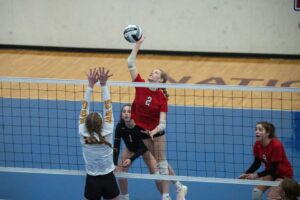
Begin near the net in a blocking stance. Perform a controlled block jump, land with both feet, then retreat or shuffle into a defensive position before receiving a tossed ball. Keep the landing quiet and bend the knees immediately.
Middle blockers can use this drill to practise moving away from the net. Outside hitters can adapt it by starting at the net, transitioning toward the attack approach, and then recovering into defense. The focus is the change of direction after landing, not the height of the jump.
How to structure a volleyball agility workout
Agility work is most effective when players are fresh enough to move precisely. After a general warm-up, choose two or three drills and perform short, high-quality efforts. Allow enough recovery for the next repetition to look sharp rather than rushed.
A practical session might begin with line shuffles, continue with a reaction drill, and finish with a movement that includes a ball. Start with predictable footwork while learning the pattern, then add random signals or live passes. This progression helps players transfer volleyball conditioning into actual court movement.
Coaches should watch the first step, the final stopping position, and the player’s posture. If technique deteriorates, shorten the work interval or increase the rest period. Agility training is not meant to become a fatigue test in which poor movement is repeated.
Common mistakes during volleyball footwork drills
- Standing too tall: An upright posture makes it harder to change direction quickly.
- Crossing the feet during every shuffle: This can reduce control when a sudden stop is needed.
- Watching the floor: Players should practise keeping their eyes forward and tracking a coach, teammate, or ball.
- Chasing maximum speed: A controlled first step is more useful than a fast but unbalanced movement.
- Ignoring the recovery position: Every drill should end with the player ready for the next volleyball action.
Surface choice also matters. Use a clean, non-slippery court whenever possible. On outdoor courts or harder surfaces common in community training environments, reduce jumping volume and check for loose gravel, wet areas, or uneven patches before beginning.
Frequently asked questions about volleyball agility drills
How often should players do volleyball agility exercises?
Most players can include focused agility work two or three times per week, provided the sessions are brief and recovery is adequate. Teams with frequent matches or intense jumping sessions may need less additional work.
Can beginners do these volleyball speed and agility drills?
Yes. Beginners should use larger movement spaces, slower speeds, and predictable signals first. Once they can stop and change direction safely, the coach can shorten the distance or introduce random reactions.
Do volleyball agility drills require a ladder?
No. An agility ladder can help with rhythm and coordination, but court lines, cones, shoes, or chalk marks are enough for most volleyball footwork exercises. Drills involving a partner and a ball often provide more sport-specific decision-making.
Should agility training come before or after volleyball practice?
Technical agility work and reaction drills usually fit best after the warm-up and before heavy conditioning. If the goal is simple conditioning, the drills can be placed later, but players should stop if fatigue causes unsafe landings or uncontrolled changes of direction.