Volleyball Pipe Attack: Timing, Technique and Common Mistakes
Learn how the volleyball pipe attack works, where the hitter takes off, how setters create the play, and what players must do to execute it legally and effectively.
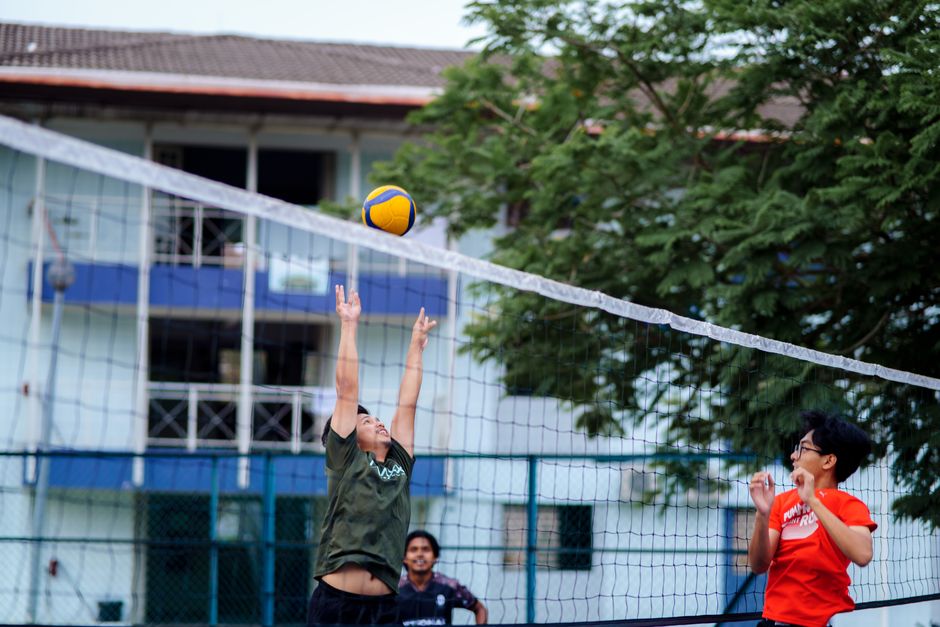
A volleyball pipe attack is a back-row attack hit from the middle of the court, usually from behind the three-metre line. It gives the setter another option through the centre and can make the opposing blockers hesitate between the middle hitter and the back-row attacker.
The pipe is not simply a regular spike taken farther from the net. The hitter must stay behind the attack line when taking off, build speed without arriving too early, and contact the ball high enough to attack around or above the block. Good coordination between the setter and hitter is the main factor that makes the play effective.
What is a pipe attack in volleyball?
In a pipe attack, a back-row player approaches the ball through the middle-back area and jumps from behind the attack line. The setter sends a fast, often slightly lower ball toward the centre of the court. The hitter then attacks before the defence has time to form a stable block.
The name refers to the route through the middle of the court rather than a fixed position on the floor. A pipe hitter may begin in middle back, move toward the centre, and adjust the approach based on the pass and the setter’s location. The attack can be run from different rotations, provided the back-row player follows the rules for position and take-off.
Pipe attack rules
- The back-row attacker must take off from behind the three-metre line.
- The player may land inside the attack zone after contacting the ball.
- The hitter must not touch the ball above the height of the net while positioned illegally in the front zone.
- A back-row player cannot complete a block or participate in a completed block.
- The attack must respect normal rules on carries, double contacts and net touches.
Officials judge the location of the player’s feet at take-off. A player who jumps from behind the line and lands beyond it has not automatically committed a back-row fault. The problem occurs when the take-off itself happens on or in front of the attack line.
How the pipe attack is executed
1. Start from a usable position
The hitter should begin far enough behind the attack line to create a controlled approach. Starting too close reduces the time available to accelerate and makes it easier to step over the line. The exact starting point depends on the player’s speed, the team’s serve-receive pattern and the setter’s preferred target.
2. Read the pass and setter
The pipe hitter should not commit to a full approach before seeing whether the pass allows the setter to play the middle. A tight or drifting pass may force the setter to choose an outside set instead. The attacker should stay available, keep the body balanced and adjust the approach rather than running blindly to a predetermined spot.
3. Match the setter’s tempo
Pipe timing is usually faster than a high outside ball but not always as quick as a first-tempo middle attack. The hitter starts the approach so the final two steps lead into the ball at the intended contact point. If the approach begins too early, the player may have to pause or jump before the set arrives. If it begins too late, the hitter loses height and reaches the ball behind the body.
4. Use a strong but controlled approach
The final two steps should convert horizontal speed into vertical lift. A powerful penultimate step helps the hitter cover distance, while the last step should be quick and stable. The player must jump from behind the attack line, keep the chest under control and avoid drifting too far forward before contact.
5. Attack the available space
The best hitting option depends on the blockers and the quality of the set. A hitter may attack sharply into the seam, roll the ball to an open deep corner, or use the block to redirect the ball. The goal is not always maximum power. A well-placed shot behind the block can be more effective than a hard ball into a prepared defender.
Pipe attack compared with other back-row attacks
| Attack | Typical route | Main purpose |
|---|---|---|
| Pipe | Middle back toward the centre | Attack the gap between blockers and use the full width of the offence |
| D ball | Right-back area | Give the setter a back-row option on the right side |
| Back-row bic | Centre-back, often with a deeper approach | Use a fast, low set through the middle |
| Back-row outside attack | Left-back area | Recreate an outside attack from behind the line |
Terminology can differ between coaches and regions. Some teams use “pipe” for the central back-row attack and “bic” for a faster variation. The important distinctions are the attack lane, the set tempo and the hitter’s starting position.
Common pipe attack mistakes
Taking off too close to the line
A hitter who starts or finishes the approach too close to the attack line may step over it during the jump. Marking a clear take-off area in training helps the player develop a legal approach without sacrificing speed.
Running before reading the set
The pipe should support the setter, not force an impossible ball. If the pass is poor, the hitter may need to slow down, cover the attack or prepare for a transition play. A reliable pipe attacker makes a late adjustment instead of insisting on the original route.
Arriving under the ball
When the set is too far behind the hitter, contact becomes low and the attacker loses options. The setter and hitter should agree on the target height and distance from the net. Video review can reveal whether the issue comes from the set, the approach or both.
Ignoring the block
A pipe attacker still needs to read the opposing middle and outside blockers. If the block closes the centre, a controlled shot to the deep corner or a tool off the hands may be the better choice. Looking only at the ball makes it harder to recognize open space.
Training drills for a stronger pipe attack
Begin with footwork without a ball. The player rehearses the approach from behind the attack line, jumps vertically and lands under control. Coaches can place a visible marker on the floor to reinforce a legal take-off point.
Next, add a setter and use consistent tosses before introducing serve receive. The hitter should focus on matching the tempo rather than hitting at full power. Once the timing is stable, vary the pass so the player learns when to continue, delay or abandon the pipe.
A useful progression is to add two blockers. The hitter must identify the seam, line and deep-court options before each swing. Scoring the drill for smart shot selection, not only kills, encourages decisions that transfer to competitive matches.
Pipe attack FAQ
Can a back-row player land inside the three-metre line?
Yes. The player must take off from behind the attack line, but landing in front of it is allowed after the ball has been contacted.
Is a pipe attack always made by the middle-back player?
No. The central back-row player commonly takes the attack, but another back-row player may run the pipe if the rotation and team system allow it.
What makes a pipe set different from a high ball?
A pipe set is generally faster and designed to reach the hitter before the defence can organize. A high ball gives the attacker more time but also gives blockers more time to close the attack.
Why does the pipe attack fail even when the hitter jumps well?
Failure often comes from a mismatch between the pass, set and approach. The set may be too low, too far behind the hitter or too close to the net. The hitter may also start too early, take off illegally or fail to read the block.