Beach Volleyball Serving Rules: Service Zone, Rotation and Faults
Understand beach volleyball serving rules, including the service zone, serving order, foot faults, screening, let serves and common service faults.
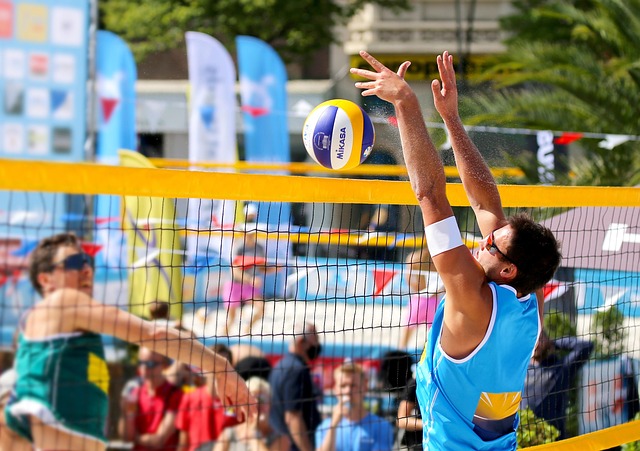
A beach volleyball rally can be decided before the ball reaches the receivers. A server who steps on the end line, serves out of order or hides the ball behind a teammate gives the other team a simple scoring opportunity. The basic rules are straightforward, but small differences from indoor volleyball often cause confusion.
Where and how the serve must be taken
The server stands behind the end line in the service zone. The service zone extends across the full 8-metre width of the court, so the player may serve from anywhere behind the line rather than from a marked corner.
The server must not touch the end line or the ground inside the court at the moment of service. This is a foot fault. A player may move freely behind the line and may leave the service zone after hitting the ball, provided the serve itself was made legally.
After the referee authorises the service, the server has five seconds to hit the ball. The ball must be released or tossed before being struck, and it may be hit with one hand or any part of one arm. Catching, holding or throwing the ball is not a legal serve.
Each team has one service attempt. If the player misses the toss, the ball drops or the serve is otherwise not hit correctly, the serving team loses the rally. A player cannot catch a poor toss and restart the serving action.
Beach volleyball serving order and rotation
A beach volleyball team has two players, and both must serve in the order recorded on the scoresheet. The team decides which player serves first at the start of the set. That order continues throughout the set.
When the receiving team wins a rally, it gains the right to serve. The player who did not serve the team’s previous service turn becomes the next server. The players therefore alternate serves rather than changing positions as six-player indoor teams do.
There are no fixed front-row and back-row positions in beach volleyball. The two players may stand wherever they choose on their side of the court during a rally. They must still respect the correct serving order, however. Serving out of order is a service fault and can affect the score and the next server under the competition regulations.
When a beach volleyball serve is legal
A legal serve crosses the net within the space between the antennae and lands in the opponent’s court, or is touched by a receiving player before going out. The ball may touch the net while crossing. This is a let serve, not automatically a fault, as long as the ball continues legally into the opponents’ playing area.
The serve may travel directly over the net or use spin and trajectory to make reception difficult. It does not need to be hit with a traditional overhead serving technique. Underhand serves, float serves and jump serves are all legal if the contact, timing and service-zone requirements are met.
The receiving team cannot block the serve or attack it above the height of the net. A player may receive the ball with any legal playing action, but the first contact must not be caught, carried or held.
Screening and visibility restrictions
The serving team must not deliberately prevent the receivers from seeing the server or the ball’s path. Teammates may not wave their arms, jump, move sideways, stand in a group or create another visual screen to conceal the serve.
A teammate can stand on the court in a normal position, but the referee may penalise the team if that player intentionally blocks the receivers’ view. This rule matters particularly on bright, windy beaches, where a receiver may already have difficulty tracking a float serve or a ball affected by sun and sand.
Common serving faults
- Foot fault: the server touches the end line or the court before making contact with the ball.
- Time fault: the server does not serve within the permitted five seconds after the referee’s whistle.
- Wrong server: the players serve in an order different from the recorded sequence.
- Illegal contact: the server catches, throws or holds the ball instead of striking it.
- Ball out: the serve lands outside the opponent’s court without being touched.
- Ball into the net: the serve fails to cross legally into the opponent’s playing area.
- Screening: a teammate deliberately obstructs the receivers’ view of the server or the ball.
A service fault normally awards the rally and the next serve to the other team. Because beach volleyball uses rally scoring, a poor service attempt costs a point as well as the right to serve.
How these rules affect match strategy
The service zone gives players room to target different receiving positions. A server can move along the end line to change the angle, serve into the wind or force a receiver to move away from a preferred passing position. The player must still check the line carefully, especially when serving from soft or uneven sand.
Teams also need a clear routine after every side-out. The next server should be confirmed before the ball is collected, and both players should communicate about wind direction, the receiver’s position and the intended target. A legal serve is only the starting point; control and placement often matter more than maximum speed.
In tournaments across Africa, local organisers may apply FIVB rules alongside event-specific procedures for warm-ups, uniforms, weather interruptions or scoring formats. The core beach volleyball service rules remain familiar, but players should check the tournament regulations if a competition uses a modified format.
Frequently asked questions about beach volleyball serves
Can a beach volleyball serve touch the net?
Yes. A serve that touches the net may continue into the opponent’s court and remain in play. It becomes a fault if it fails to cross legally or lands out without being touched.
Can you serve from anywhere behind the line?
Yes. The server may use any position behind the end line within the service zone. The player must not touch the line or the court before striking the ball.
Do beach volleyball players have to rotate positions?
No. Beach volleyball teams do not rotate through front and back positions. The players must follow the recorded serving order, but they may choose their positions on court during play.
How many chances do you get to serve?
There is one service attempt. A player cannot catch or retrieve a bad toss and try again.
Can a teammate stand in front of the receiver?
A teammate may stand on the court, but cannot deliberately screen the receiver by blocking the view of the server or the ball’s flight.